Blog
Part 3. One Species or Many? The Taxonomic Puzzle of Cephalotaxus 🧩
One of the most important things to consider when studying Cephalotaxus is the name itself. Should populations that look similar be treated as a single, broadly defined species, or divided into several distinct species? Taxonomists do not always agree.
In this final article, we explore the taxonomic debate surrounding Cephalotaxus across the Korean Peninsula, Japan, China, and Taiwan, and examine why research on genetic diversity matters for medicinal plant research as well.
Can Korean Populations Be Classified as Separate Species?
Korean populations of Cephalotaxus have sometimes been divided into Cephalotaxus harringtonii and a form known as nune gaebija namu. Proposed distinctions have included whether the plants grow upright or creep along the ground, the length of their leaves, and the length and width of their young branches.
However, the original article urges caution when dividing Korean populations into separate taxonomic groups based on these characteristics alone.
In the wild, creeping and upright growth forms often occur along a continuum, depending on growing conditions. Leaf size and plant height also show broad variation rather than clear-cut differences. For this reason, some researchers argue that growth habit or plant size alone provides insufficient grounds for recognizing separate species.
The Question of C. sinensis in China
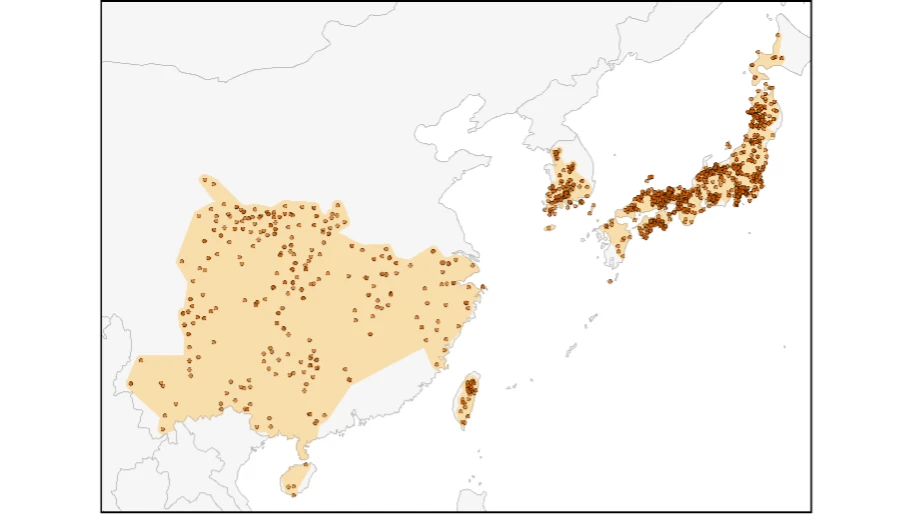
In the past, Cephalotaxus harringtonii was used to refer to the plants found in Korea and Japan, while the genus was sometimes considered absent from the wild in China. Today, however, taxonomists continue to debate whether C. sinensis, found in mainland China, should be included within a broadly defined C. harringtonii or recognized as a distinct species.
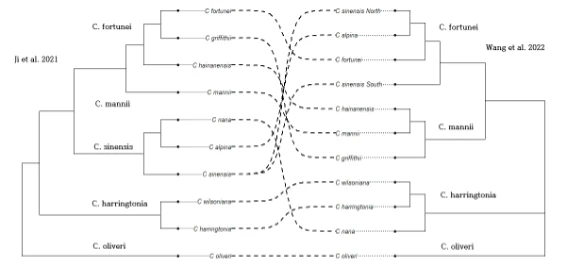
Many chemical studies conducted in China have reportedly used plant material identified as C. sinensis or C. hainanensis. Yet phylogenetic analyses often place these materials close to lineages associated with C. mannii or C. fortunei. This makes the relationship between the names used in research and the plants' actual evolutionary lineages far from straightforward.
There is also the possibility that northern and southern populations identified as C. sinensis may represent different taxonomic groups.
What Molecular Phylogenetic Studies Tell Us—and What Remains Unclear
Chloroplast genome studies published in 2021 and 2022 have provided valuable insights into the broader evolutionary relationships within Cephalotaxus. Although the detailed branching patterns differ between phylogenetic trees, the distinct identities of mainland Chinese species such as C. fortunei, C. mannii, and C. oliveri appear to receive some support.
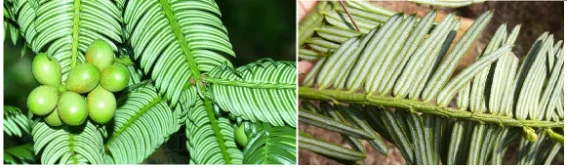
The identity of C. sinensis, however, remains uncertain. C. oliveri has relatively broad leaves that characteristically curve inward, making it somewhat easier to distinguish. Other species can be much harder to identify based on morphology alone.
Differences in winter bud size, leaf length, and whether a plant grows as a tree or shrub may overlap with variation caused by environmental conditions. The original article therefore emphasizes that the taxonomic framework for the evolutionary relationships and morphological classification of East Asian Cephalotaxus still needs further refinement.
What Low Genetic Diversity Tells Us About Korean Populations
A study by Hong et al. (2014) examining native Korean populations of Cephalotaxus harringtonii found that genetic variation occurred primarily among individual plants, with no clear genetic differentiation between regional populations. Overall genetic diversity was also reported to be low.
Although the Wando and Hwasun populations showed some differences from populations in central Korea, the results did not reveal a clear geographic pattern of genetic structure.
In Korea, Cephalotaxus harringtonii occurs as far north as parts of Gyeonggi Province, but its main populations are found in the understory of low-mountain forests in Jeollanam-do and Jeollabuk-do. When comparing southern Korean populations with those across the Japanese archipelago, the history of glacial refugia and differences in population size suggest that genetic diversity may be higher in Japan.
| Broadly defined species | An approach that groups similar populations together and treats them as a single species. |
|---|---|
| Synonym | An alternative scientific name for the same organism that is not currently accepted as its formal name. |
| Chloroplast genome | The complete set of DNA found in a plant's chloroplasts, often used to investigate evolutionary relationships. |
| Topology | The branching pattern that describes how lineages are connected in a phylogenetic tree. |
| Genetic diversity | The degree of genetic variation present within a species or population. |
The genus Cephalotaxus cannot be understood through a single medicinal compound alone. Which species was studied, whether its scientific name accurately reflects its evolutionary lineage, and how much genetic diversity exists within Korean populations all influence how research findings should be interpreted.
For future research and the sustainable use of these plant resources, a more integrated approach—combining chemical analysis, taxonomy, and genetic diversity studies—will be essential.
 PhytoRevolution Blog Coming Soon
A space for deeper, more professional stories on plant
research and active ingredients