Blog
Part 1. Discovering Cephalotaxus harringtonii in the Shaded Forest 🌿
When we come across a low-growing conifer along a forest trail, it is easy to dismiss it as just another yew-like tree. But Cephalotaxus harringtonii, though similar in appearance to yew and Japanese torreya, belongs to a different genus and has also earned a place in medicinal plant research.
In this first article, we explore where Cephalotaxus harringtonii grows and how to recognize it in the field, even without a background in botany.

A Small Conifer That Thrives in the Shade
Cephalotaxus harringtonii is a shade-tolerant plant that grows in the understory beneath taller trees. It tolerates shaded conditions better than places exposed to intense sunlight and is relatively resilient to both cold and heat. These qualities also make it a fairly easy plant to maintain as an ornamental.
That does not mean it is entirely free from pests and diseases. Reported problems include pine needle rust, Phytophthora root rot, Armillaria root rot, and leaf blight, along with pests such as spider mites and weevils. However, these issues are not generally considered major threats in cultivation.
The Underside of the Leaf Offers the Clearest Clue
Cephalotaxus, Taxus, and Torreya all have needle-like leaves, making them look quite similar from a distance. Look at the undersides of their leaves, however, and the differences become much easier to see.
Yew leaves appear pale green underneath, without prominent white stomatal bands. Japanese torreya, by contrast, has two thin white lines running along the underside of each leaf.
Cephalotaxus harringtonii has much broader, more prominent white stomatal bands. Simply turning a leaf over can therefore offer a useful clue to its identity in the field.
Another helpful distinction is their growth habit: native yews and Japanese torreya in Korea grow as trees, while Cephalotaxus harringtonii typically takes the form of a low-growing shrub.
What Looks Like a Fruit Is Actually a Seed
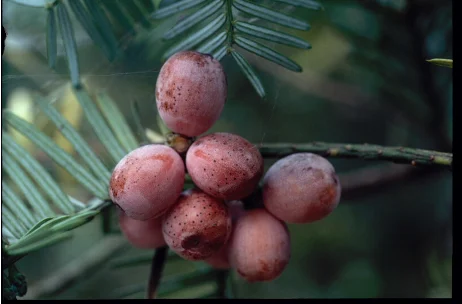
The fruit-like structures of Cephalotaxus harringtonii are actually seeds surrounded by a fleshy seed covering called an aril. Because their appearance resembles that of a plum, the plant is known in English as Japanese plum yew.
Despite its familiar, approachable name, this plant is more than an attractive ornamental. It sits at the intersection of East Asian plant taxonomy and natural products research.
| Shade-tolerant plant | A plant that grows well in shaded conditions rather than under intense sunlight. |
|---|---|
| Stomatal bands | Stripe-like areas on the underside of leaves that contain stomata. They provide an important clue for identifying conifers. |
| Aril | A fleshy covering around a seed that can make it look like a fruit. |
| Trees and shrubs | Trees typically grow tall with a distinct trunk, while shrubs tend to be shorter, with multiple branches emerging near the base. |
The first clues to understanding Cephalotaxus harringtonii are not complicated Latin names, but the undersides of its leaves and the way it grows.
In the next article, we will explore why this small shrub has attracted attention in anticancer and antiviral research—and why obtaining a reliable supply of its raw material is not so straightforward.
 PhytoRevolution Blog Coming Soon
A space for deeper, more professional stories on plant
research and active ingredients